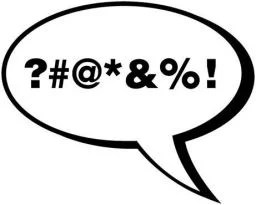
Oops, were your sensibilities shocked?
“May the words of my mouth and the meditation of my heart be acceptable in Thy sight, oh Lord!” This is certainly a prayer of mine and lately it has been a subject of much consideration. To be honest, the topic and what I will be sharing can be a controversial one at the least and a topic that separates friends and even family members at worst. It seems to be one of those things that is a game changer so to speak. Have you ever thought or heard, “I just don’t want my children hanging around their children. Their language is just vulgar!” Or “Did you hear what he said? Can you believe that a Christian man would use that kind of foul language?” Maybe you’ve heard this one, “Godly men and women just don’t use 4 letter words!” Recently, while with a group of believers, I listened while women exhorted one another against using those 4 letter words that offend. “We are supposed to be a light in this dark world… how can we be that if we are expressing ourselves with this kind of language?” All heads nodded and everyone agreed…. I had uncomfortable thoughts. Stick with me.
I’m not suggesting that you walk around using what our culture considers curse or swear words. I’m not suggesting that profanity is beautiful language: something poetry should be written from. In fact, I would argue that often these words are used as fillers when a sentence would be perfectly complete without them. In other words; unneccessary fillers. What I am suggesting is that we think more deeply, consider the depth of the meaning of the Word of God when it speaks of our communication. I would even suggest that our words have more to do with culture than with “godliness” or being a light in a dark world. This may be a long one, because there is much to lay out for consideration – but let’s do this!
Most Christians’ minds go to the same place when speaking of “corrupt communicaton” or Biblical references to our speech. We immediately have a list of “off limits” words that are unacceptable for a godly person to use, right? You can probably immediately make a mental list of those words. I know I can. But let me ask you this. Did the believers of the 18th century for example have that same list? Will the believers 30 years from now have the same list? It is quite possible that there may be some words that make all of the lists – but the truth is our accepted word use has changed and will continue to change. Even the understood meanings of words change with cultures. This is why my grandfather’s usage of certain words and my grandson’s usage of the same words do not elicit the same response.
Our English language originated where? The Latin language. Historically, what was socially acceptable in the Latin culture determined what was socially acceptable to say. Without going into detail about what was considered morally acceptable in the 1700’s, we will just look at how that played out in how Latin men insulted one another – which is what was considered profanity at the time. In their “profanity” they didn’t use terms that depicted sex acts; but they used terms that depicted the man as passive. This was the greatest insult you could throw at a man at this time. (that he was passive)
Of course, if we are looking historically, we need to start with Bible times! “By his name alone you shall swear” “Swearing” in the Bible refers to oaths, promises before God that your words are true or that you will do what you say you will. Using God’s name falsely; swearing by His name while lying was considered a dangerous practice then and should be considered a wrong practice today.
Although many of today’s swearwords were in use by the 15th century, they were not obscene at this time. They were simply direct terms for the things they represented. Words that are considered obscene today appeared everywhere in the Middle Ages; in street names (Gropecuntlane, Shitwellway, Fuckinggrove), personal names (Gunoka Cuntless, Godwin Clawcunt, Thomas Turd), the names of common plants and animals (a heron was a shiterow; the medlar was the open-arse tree), in literary texts and medical treatises (“in women the neck of the bladder is short and is made fast to the cunt”), and in translations of the Bible (“the Lord will smite you with the boils of Egypt [on] the part of the body by which turds are shat out”).
One of the words that I personally despise the most today is what is known as the f-word. Interestingly, scholars argue about when the f-word was first used in a sexual sense and from there became an “ugly” word in our culture. Now, I don’t know anyone with a name even close to this, but the name Roger Fuckbythenavel was recently discovered in the Chester County Court rolls of 1310-11. This discovery has reignited debate about when the f-word was first used in a sexual sense. There are earlier examples of it in names – John le Fucker (1278), Henry Fuckbeggar (1286), Simon Fuckbutter (1290)– but scholars usually explain them away as misspellings or closely related to Germanic words meaning “to hit” or “to strike”. Of course, if that was the understood meaning, Henry would then be known for walloping beggars, not sleeping with them. The first “real” use of the f-word is thought to occur in a poem partly written in cipher from around 1475, which complains that some monks are damned because they “fuccant” women around the monastery. Fuckbythenavel could be an example of either sense, really– it could refer to striking someone in the belly or some sexual proclivity. Without context, we just don’t know. But I look at this information and I think, “The good ole days?” Can you imagine the uproar if you and I found poetry like this on our coffee tables today?
In the Renaissance, the power of oaths began to decline. In other words, the shock value wasn’t there anymore! During this period the most shocking words a person could utter before now became mild expletives; only slightly more offensive than “um” or “uh”. 17th- and 18th-century conversations were peppered with ‘sblood (“God’s blood”), zounds (“God’s wounds”), and a new one, bloody. What was considered the worst thing you could say in this period? “By God’s bones!” This is an example of vain swearing. Such oaths were the most obscene language of the Middle Ages. There are many versions – “by God’s wounds,” “God’s nails,” “by the blood of Christ,” as you could swear by more or less any body part. These phrases were so offensive because they were thought to be able to rip apart the body of Christ as it sits at the right hand of God in heaven.
Words that had previously been considered as simply direct communication soon started to take over as the new obscenities. The transition was rough, however – sometimes words were censored, and other times they still appeared in print. In fact, in 1616 George Chapman published a beautiful, expensive edition of Homer in which he attacked one of his critics as “an envious Windfucker”.
Then, there was the Victorian Age: The age of the Euphemism. When I think of the Victorian Age I think of “socially proper.” Appearances were of utmost importance! What they considered obscene words were thought to be horrific and most offensive during this era. They disappeared from print and most speech, and any word that even pointed roughly in their direction was euphemized. Victorians avoided trousers and instead referred to inexpressibles, indescribables, etceteras, unmentionables, ineffables, indispensables, innominables, inexplicables, and continuations. Leg became limb or, even better, lower extremity. Kissing became osculation; people stopped sweating and started perspiring. If you are like me; you don’t even know what many of the above words meant!
I find the study of the history of language fascinating. I also find it interesting to look at our amazing brains and how language is processed and how language usage affects us. Did you know that in our brains, swearwords are stored and processed differently from other language? Most propositional speech-words strung together in an original form-is a product of the left hemisphere of the brain. Swearwords, though, come mostly from the limbic system in the right hemisphere. This explains why people whose left hemispheres have been destroyed by strokes or Alzheimer’s disease often still swear. The limbic system records the emotional content of words, which is why swearing seems to work to relieve pain and frustration, and to praise or insult other people. These words access and give vent to our emotions in ways other words cannot. Interesting, huh?
Today the words considered to be the worst words in the English language are racial slurs. But we are getting more and more offended by epithets of any sort to be honest. It is becoming more and more taboo to essentialise anyone or anything in a single word, as epithets do, whether that word sums up a person by race, mental acuity (retard), physical disability (cripple), or size (fat). These are the swearwords of the future. Culture dictates much!
Does your brain hurt yet? Mine does! Why have I bothered to go through the history and processes of language like this? Because I believe it is so important to understand that while language and culture changes; what God is speaking of when He addresses our communication: well, it’s much deeper! I apologize if even reading the above information was offensive to you. That was not my intent. My true intent? To encourage both you and I to be offended by the deeper matters, to care more about what God truly cares about.
Now, don’t assume that I am advocating for us to not be careful in our speech. I believe discernment is one of the things the Bible speaks of repeatedly- something that all believers should pray for: wisdom and discernment in all areas of our lives. Why are we all familiar with the phrase, “Swear like a sailor”? Because time and place, company, situations, culture all play into what is appropriate in choosing our words. Personally, I’m more comfortable with a male using strong words than a female – I also prefer femininity in every aspect of the female life and harsh and feminine don’t mesh in my mind. That’s a personal preference and something that I personally hold to without it coloring my opinion of you if you disagree.
But here is the meat of this discussion. What should my concern be if I am striving to be a light in this dark world? What should my concern be if I am striving to honor God with my communication? How about: Whether my communication with another human is life giving or deflating? Whether my speech hurts another human or lifts them up. Whether my speech encourages the hearer or makes them feel defeated. Whether my speech makes someone feel loved or rejected. Whether my speech imparts value to another or strips them of their dignity. Whether my speech brings joy or pain to the hearer. Whether my communication makes someone feel welcome or a bother. Whether my communication expresses disgust or joy in their presence. Whether my communication lightens the burden of another or adds to it. Whether my communication gives hope or dispair. Whether my speech praises or criticizes another.
Some of the most vile language that I’ve ever heard has come from the mouths of those who would never speak a 4 letter word, or express themselves with cursing. They bow their heads in shame and disappointment when someone else says a word they find offensive and yet they regularly discourage with their words, they rarely say anything complementary to another. They find fault and express their “concern” every time you are in their presence. They will not hesitate to mock or chide others and they are quick to point out mistakes. These same people are often the most rude to waiters or waitresses in restaurants, are haughty and arrogant when speaking to family and friends and think nothing of expressing their negative opinion when not asked. In other words, while no improper language ever crosses their lips they often leave people destroyed in their wake – simply by the words they do speak. THIS should concern us. This concerns me greatly.
May my words, my communication be for the edification of others and not for their corrupting! May the love and life expressed in my language be a true light in this dark world and if I stump my toe and the word “shit” passes through my lips may you giggle with me understanding what truly matters.
Make a one-time donation
Thank you so much for your support of my writing and ministries!
Make a yearly donation
Choose an amount
Or enter a custom amount
Your contribution is appreciated.
Your contribution is appreciated.
Your contribution is appreciated.
DonateDonate monthlyDonate yearly


Leave a reply to mommajoy9 Cancel reply